

Routing AI work across the cheapest, most reliable hardware path.
AI cost is usually framed as a model problem.
Which model is cheaper? Which model has the best quality? Which model has the lowest latency? Which model has the largest context window?
Those questions matter, but they miss a deeper layer.
AI cost is also a compute placement problem.
Most AI systems default to cloud inference. A request comes in, a cloud model processes it, and the answer comes back. That is simple, but it is not always efficient.
Many tasks do not need the same compute path.
Some workloads need frontier cloud models. Others can run on local CPUs, Apple Silicon, Metal GPUs, edge devices, small open-source models, specialized accelerators, or elastic GPU clusters.
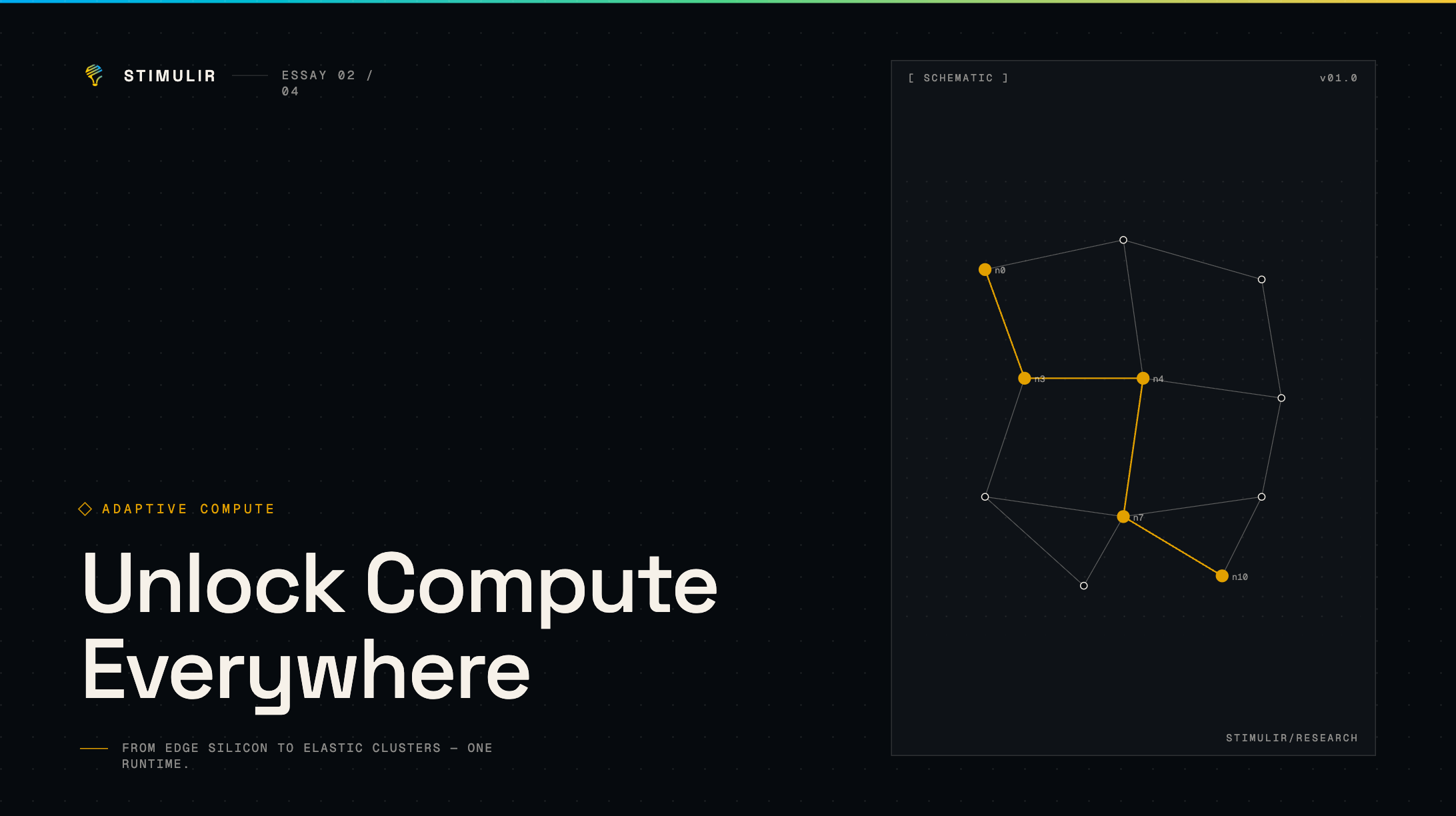
Adaptive compute is the idea that AI workloads should move across heterogeneous hardware based on the task, environment, cost, privacy, latency, and reliability requirements.
The future AI runtime should not assume one compute path.
It should adapt.
A high-risk business decision may justify a frontier model in the cloud. A known classification pattern may run on a smaller local model. A repeated visual task may run through a specialized image or video pipeline. A private workflow may stay on-device. A post-training job may run on cheaper available GPUs. A lightweight adapter may be trained using local or rented compute instead of repeatedly paying frontier inference costs.
Apple Silicon and Metal GPUs matter here.
For many teams, the cheapest available compute is already sitting on their desks. Local machines with Metal acceleration can run smaller models, embedding pipelines, eval loops, adapters, transcription, visual inspection, and parts of post-training workflows.
They will not replace frontier cloud models.
But they can reduce unnecessary cloud usage for known patterns.
This is especially important when combined with adaptive intelligence.
If a frontier model discovers a useful pattern, and that pattern can later be distilled into a smaller model or adapter, then adaptive compute decides where that smaller execution path should run.
Maybe it runs locally.
Maybe it runs on a Mac using Metal.
Maybe it runs on an edge device.
Maybe it runs on a cheaper GPU cluster.
Maybe it falls back to cloud inference when quality drops.
The routing decision becomes part of the intelligence.
Stimulir’s adaptive compute thesis is that AI systems should treat compute as a dynamic resource, not a fixed destination. The runtime should know what kind of task it is handling, what confidence level is required, what hardware is available, and what cost profile is acceptable.
This unlocks cheaper pathways for both inference and post-training.
Post-training is especially important. If every adaptation loop depends on expensive centralized infrastructure, continual learning becomes too costly for many workflows.
But if the system can use heterogeneous compute, including local hardware and Metal GPUs, then repeated adaptation becomes more practical.
The goal is not to run everything locally.
The goal is to stop running everything through the most expensive path by default.
Adaptive compute means the system chooses the cheapest reliable hardware path for the job.