
Adaptive Intelligence: Introducing Stimulir's Adaptive Inference

Turning expensive frontier-model reasoning into reusable execution.
Most AI systems treat every task as if it is happening for the first time.
A user asks for something, the system sends the request to a frontier model, the model reasons through the task, generates an answer or action plan, and the process repeats the next time a similar request appears.
That works, but it is expensive and structurally wasteful.
Frontier models are extremely useful when the pattern is unknown. They are valuable for new workflows, ambiguous decisions, high-risk actions, unfamiliar business contexts, and tasks where the system does not yet know the best path. In those cases, paying for frontier reasoning makes sense.
The model is discovering the route.
But once the route is known, the economics change.
If an AI system has already solved a workflow, produced a successful outcome, passed review, and generated an evidence trail, the next similar run should not cost the same. The system should learn from the trace.
This is the core thesis behind Stimulir’s adaptive intelligence layer:
Use frontier models to discover and verify patterns, then convert those traces and trajectories into cheaper, specialized execution paths.
A trace is not just a log. It is a record of how the system reasoned, what tools it used, where it hesitated, which outputs were accepted, which actions were rejected, and what evidence supported the final result.
Over time, these traces become training material.
They can be used for evaluation sets, reinforcement learning signals, preference data, distillation, smaller specialist models, and lightweight adapters over open-source models. Known workflows can move away from expensive general reasoning and toward reliable, lower-cost execution.
This does not mean replacing frontier models.
It means using them more intelligently.
A frontier model should handle the unknown. A smaller model or adapter should handle the known. A policy engine should decide when confidence is high enough to use a cheaper path, and when uncertainty requires escalation back to a frontier model or a human reviewer.
The result is an adaptive inference system.
Instead of asking:
Which model should we use for everything?
The system asks:
What level of intelligence does this pattern require right now?
Some tasks need frontier reasoning. Some need a distilled specialist model. Some need a skill adapter. Some need retrieval. Some need a deterministic tool. Some need human approval.
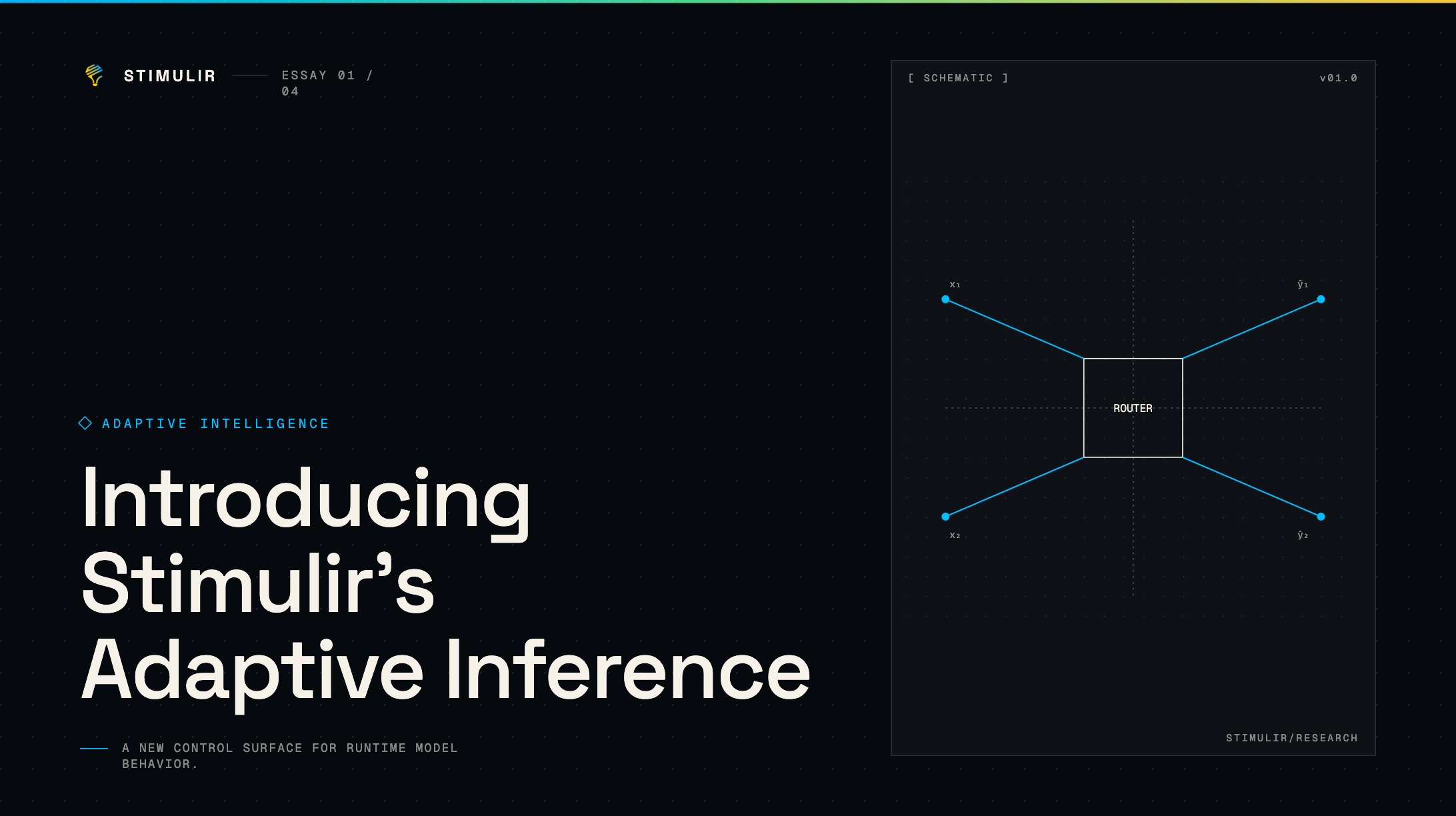
Adaptive intelligence is the layer that routes between them.
The long-term advantage is cost and reliability. If a business repeats the same operational patterns every week, month, or quarter, the AI system should get cheaper and better at those patterns over time.
Month-end close, investor updates, QA review, release notes, support summaries, campaign reports, visual editing, and compliance checks should not start from zero every time.
They should become learned execution paths.
Adaptive intelligence is how expensive reasoning becomes reusable execution.