

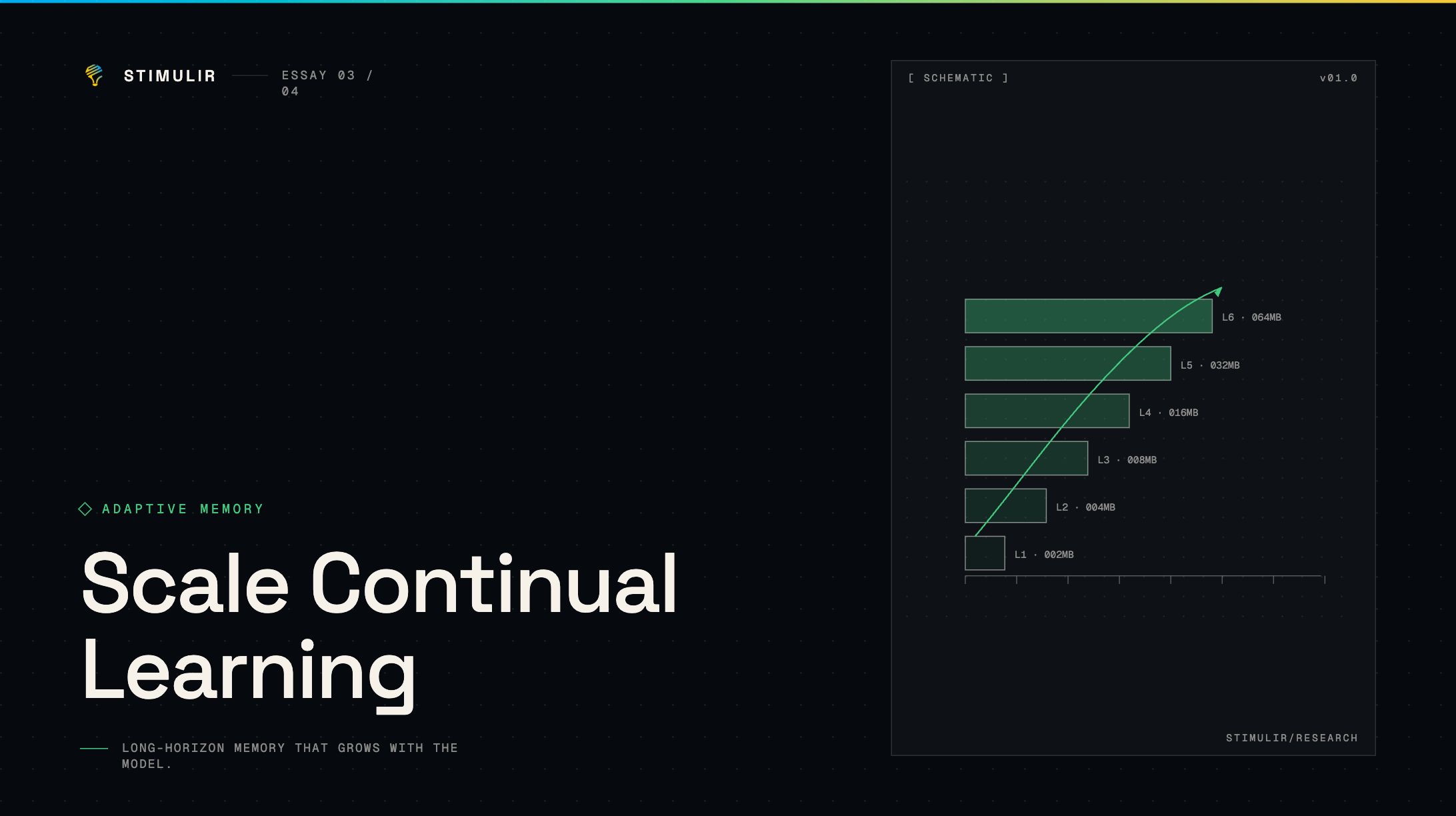
Long-horizon memory that grows with the model.
Most AI memory today is shallow.
A system stores past conversations, retrieves relevant snippets, inserts them into context, and calls that memory. This is useful, but it is not enough for agents that are expected to operate inside real businesses over long periods of time.
Real memory should not only help a model recall.
It should help the system adapt.
Stimulir’s adaptive memory thesis is that agents need long-horizon memory that grows with the model. Not one giant memory store. Not endless chat history. A layered adaptation system where repeated patterns become more useful over time.
At the business level, memory captures how an organization works: finance rules, reporting formats, approval patterns, risk thresholds, customer segments, operating cadence, and domain constraints.
At the user level, memory captures how an individual works: tone, preferences, escalation habits, approval behavior, evidence requirements, and expected output shape.
At the workflow level, memory captures repeated trajectories: what the agent tried, which tools worked, where it failed, which outputs were accepted, and what evidence supported the final decision.
At the skill level, memory becomes adaptation.
This is where D2L adapters, PEFT, and low-rank adaptation matter. Instead of forcing every learned pattern into a longer prompt or larger context window, the system can convert repeated behavior into lightweight adapters.
A finance adapter may learn how a company structures board updates.
A user adapter may learn how a CFO prefers variance explanations.
A workflow adapter may learn the reliable path for month-end reconciliation.
A skill adapter may learn how to inspect traces, summarize browser-agent runs, create release notes, or prepare validated reports.
The point is not to remember everything.
The point is to learn the right pattern at the right layer.
This is continual learning in a practical sense. The system improves as it observes successful execution, but the improvement remains scoped. A user-level memory should not rewrite business policy. A business-level pattern should not leak into another tenant. A skill adapter should only activate when the current task matches the learned pattern.
That constraint matters.
Adaptive memory must be governed, auditable, and reversible. The system should know what was learned, where it applies, why it applies, and when it should be ignored. Memory without boundaries becomes drift. Memory with structure becomes leverage.
This is why adaptive memory belongs inside the Stimulir control plane.
The agent should not simply retrieve old context. It should decide whether the current task matches a known pattern, whether an adapter should activate, whether the memory is trustworthy, and whether the output still needs review.
As memory compounds, the system should become cheaper, faster, and more personalized.
Known business patterns should not be rediscovered every time.
Known user preferences should not be re-explained every session.
Known workflows should not restart from zero.
Known skills should improve with use.
Adaptive memory is how agents move from one-off assistance to long-horizon operational learning.
It is memory that grows with the model, without losing control of where that memory belongs.