

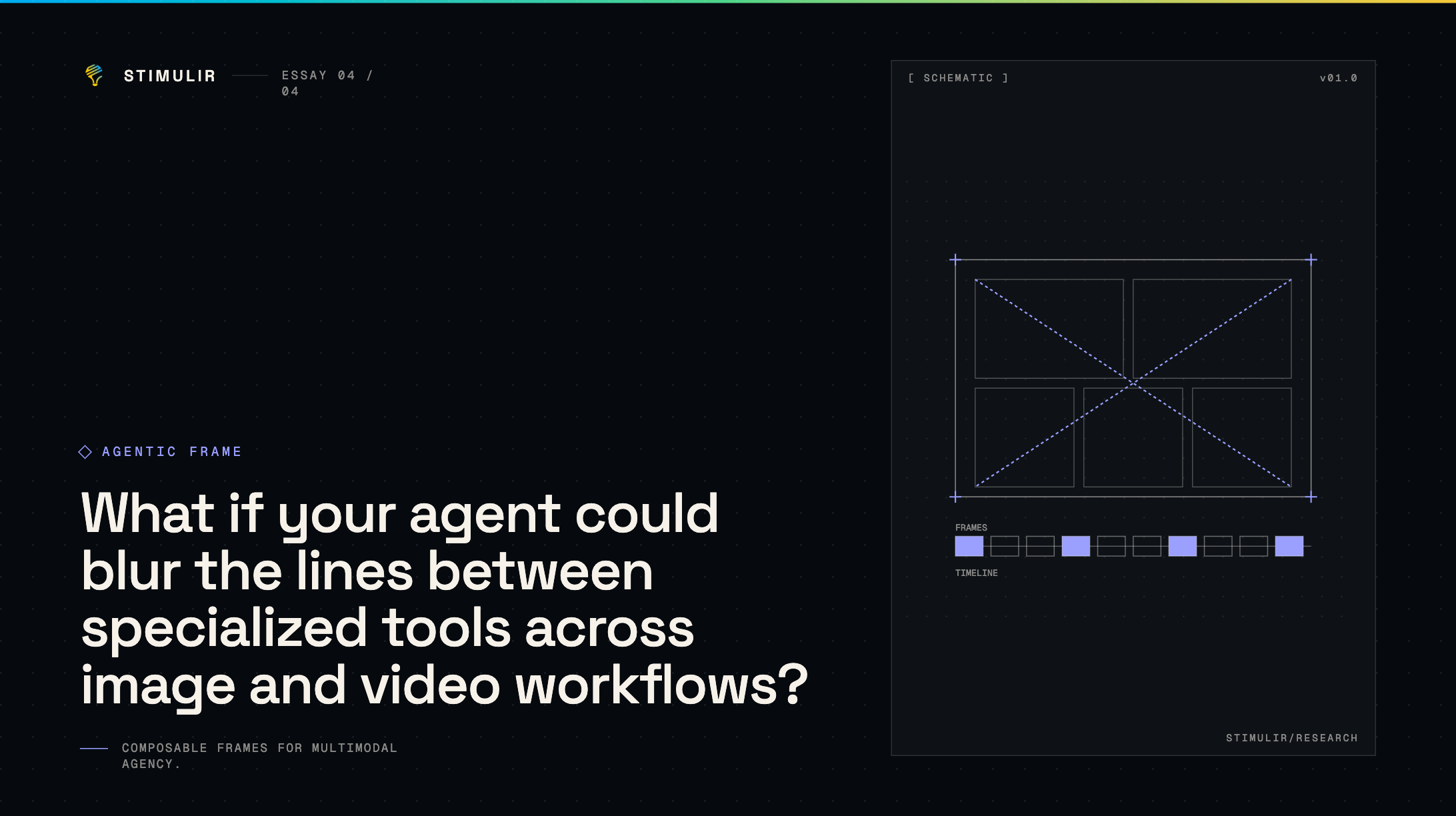
Adaptive inference for visual work.
Agentic Frame is the applied proof of adaptive intelligence.
Most people think of visual work as software specialization.
Video editing requires editing software. Motion graphics require animation tools. Captions require timing systems. Image workflows require design tools. Quality review requires human taste and attention. Publishing requires format knowledge.
A skilled operator knows how to move between all of these tools.
The question behind Agentic Frame is:
What happens when an agent can do that routing?
Agentic Frame turns visual production into an agent skill. The agent does not just generate a video from a prompt. It reasons through the workflow.
It reads transcripts.
It identifies useful segments.
It plans an edit.
It creates an EDL.
It routes inference through HybrIE.
It renders deterministically with ffmpeg.
It generates Manim overlays.
It checks timing.
It prepares the output for review.
That matters because visual work is not one task.
It is a chain of specialized subtasks.
A good video may need transcript understanding, narrative selection, cut planning, subtitle generation, motion graphics, audio normalization, visual inspection, brand consistency checks, safety review, and final rendering.
Each part may require a different capability.
This is where adaptive inference becomes visible.
The agent decides which capability belongs where. It may use a language model to reason about the narrative, a speech model to process transcripts, deterministic rendering through ffmpeg, Manim for technical overlays, a visual model for inspection, and AI Proctor for quality review.
AI Proctor is important because generation is not enough.
An agent that creates visual media also needs to inspect it.
Does the caption match the spoken words?
Does the overlay block important content?
Does the video make a claim that is not supported?
Is the timing awkward?
Is the output off-brand?
Is the visual evidence strong enough?
Should a human approve this before publishing?
AI Proctor becomes the governance layer for generated media.
It can review quality, safety, claims, captions, timing, brand consistency, and visual correctness. It can flag weak evidence, hallucinated transcript segments, or outputs that require human approval.
This turns visual generation from a one-shot creative act into a governed execution path.
The use cases are broad.
Agentic Frame can generate product demos from raw screen recordings. It can turn research papers into animated explainers. It can create AI-proctored training videos. It can generate release-note videos from commits and PRs. It can produce sales clips personalized by customer segment. It can inspect ads, thumbnails, captions, and brand consistency.
It can help teams create visual content without requiring every user to become a specialist in editing software.
The deeper point is not video.
The deeper point is that adaptive intelligence can collapse specialist workflows into reusable agent skills. Once the system learns the pattern, future runs should become cheaper, faster, and more reliable.
Agentic Frame shows what adaptive inference looks like when the task is visual, temporal, and tool-heavy.
It is not just an agent using tools.
It is an agent routing work across specialized capabilities, reviewing its own output, and escalating when confidence is low.